( DAC'19 Item 10a ) ----------------------------------------------- [03/04/20]

Subject: Cadence Perspec PSS "smorgasbord" strategy is Best of 2019 #10a

PERSPEC TIES WITH INFACT: A big upset this year in the PSS Wars.  For 2017
and 2018, with the users Cadence Perspec easily beat out Mentor InFact, with
Anirudh's Perspec ranking #1 and #2 with the users those years.

             http://www.deepchip.com/items/dac18-02a.html
             http://www.deepchip.com/items/dac17-01a.html

But this year's user comment word count on PSS tools broke out to:

  Cadence Perspec 2019: ################################# (2,145 words)

    Mentor InFact 2019: ################################ (2,082 words)

   Breker TrekSoC 2019: ## (119 words)

Putting both Perspec and InFact into a statistical tie for 1st place; and
poor Breker TrekSoC is left behind in a waaaaaay distant 3rd place.  My
analysis is Perspec is still going very strong with the users -- but InFact
is moving up by doing a very different task that only *involves* PSS.
(See DAC'19 #10b for details.)

        ----    ----    ----    ----    ----    ----    ----

SHINY NEW THING: The holy grail of PSS is the idea of a *portable* set of
tests being used across every stage of chip design & implementation is very
alluring to chip engineers. Cadence Perspec users continue to do that.

Portability
|

|

new native C API
|
The sexy "new" thing that Anirudh's R&D added to his Perspec PSS this year
is a new native C API to drive VIP on UVM-based testbenches plus in the
top level SoC verification environment.

        ----    ----    ----    ----    ----    ----    ----

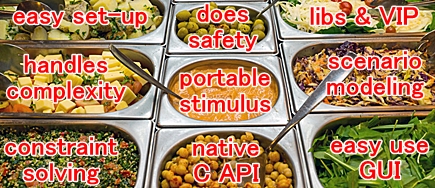
THE SMORGASBORD STRATEGY: In the user comments here you'll see Perspec offers
a smorgasbord of things it can do from pre-silicon to System Verilog to
post-silicon; all using one set of tests within one contiguous flow.
That is, Anirudh is taking the "we do it ALL" approach to PSS.

    "Our current plan is to leverage Perspec's generated tests on
     Xcelium and Palladium."

        ----    ----    ----    ----    ----    ----    ----
        ----    ----    ----    ----    ----    ----    ----
        ----    ----    ----    ----    ----    ----    ----

      QUESTION ASKED:

        Q: "What were the 3 or 4 most INTERESTING specific EDA tools
            you've seen this year?  WHY did they interest you?"

        ----    ----    ----    ----    ----    ----    ----

    Cadence Perspec

    Perspec lets us generate system-level scenarios based on a model of the
    scenario state space in a standard language (PSS).

    We rely on Accellera's PSS standard, and do not have any SLN legacy.

    Our three main interests for using Perspec are:

        - Modeling complex system level scenarios on our C-centric
          platform where we primarily develop directed tests.

        - Perspec introduces randomization at the system level, which
          would be tedious and time consuming to address with other
          verification methodologies.

        - Ease the modeling of complex scenarios on top of UVM testbench.

        - We want to reuse PSS models between our IP testbenches in UVM
          and our top level C-centric platform.

    Perspec also allows to have some functional coverage on the scenarios.

    Modeling

    Overall, I am expecting a 3x efficiency improvement in scenario modeling
    with Perspec.

    PSS modeling is quite straightforward, especially if you have some HVL
    background.  "Specmaniacs" will love its simplicity versus modeling
    sequences with SV/UVM.

    Perspec has a new compliant PSS model library for common processor
    actions and memory operations, with code examples for PSS modeling.  We
    have not yet used it, so we don't know if it's any good or not.

    Other stuff we like about Perspec

      - Native C API.  We are using Perspec's native C API to drive our
        VIP on UVM-based testbench and top level SoC verification.

      - Portability.  Our current plan is to leverage Perspec's generated
        tests on Xcelium and Palladium.  We do not yet have plans for FPGA
        or post silicon.

      - Constraint Solving.  Perspec has a good constraint solving
        mechanism, which is very close in flexibility to Specman.  It
        is missing path constraints at this stage.

      - Indago debug integration.  This might be useful but is not yet
        widely used by our team.

    I'd recommend Perspec, both for generating System level C tests and to
    drive complex sequence on top of a UVM testbench.  The first tests can
    be ready in only a few days.

        ----    ----    ----    ----    ----    ----    ----

    We use Cadence Perspec for design verification.

    One way we use Perspec is to verify unexpected coherency conditions that
    might occur in the system at an earlier stage.  Before we had Perspec,
    it required super long iterative Verilog simulation tests in VCS to
    reproduce this rare condition.  So, we could only realistically test for
    these conditions during post-silicon software validation.

        - With Perspec, we can now run those tests much earlier -- during
          simulation.

        - We run many scenarios in parallel at a low cost to compensate for
          the very slow execution speed of a single VCS simulator.

        - By simplifying the features and conditions we want to verify as
          much as possible, we can achieve our desired result during Xcelium
          simulation by running many short tests.

    Test Portability and Reuse

    Testing portability across different verification platforms is very
    important to us.  Through Perspec's SLN file, our DV team's Xcelium
    verification information can be reused by our software validation team
    using Palladium Z1, and by our product development team in a silicon
    environment.

    This PSS scenario portability is a great help when our teams using
    different platforms need to share and analyze a particular scenario.

    Perspec Library

    It was very impressive to control PCIe VIP through the Perspec PCIe
    library.  In general, it was very difficult to control the operation of
    external PCIe devices implemented as VIPs using C code running on the
    CPU.  However, Perspec PCIe library provides DPI (Direct Programming
    Interface) for controlling the external PCIE VIP (of course only for
    Cadence VIP).  This allowed us to control the VIP to perform the
    desired behavior at the desired time, thus creating various verification
    scenarios for PCIe.

    Bringing up the first tests

    Perspec generates the test code according to the scenario described by
    PSS.  Then, create a compile-able file using the prepared system
    initialization code.  This file will be compiled with the software
    platform libraries you are using and will be created as an executable
    image on the DUT.

    All you need to do is to fill the initialization code with the
    Perspec-supplied template and link the Perspec actions with your
    low-level APIs so that Perspec actions can access your hardware.

    The time it takes depends on the architecture and complexity of your SW
    platform.  However, once this environment is set up, it is much faster
    and easier to generate test code with various conditions than when
    writing test code manually.

    Safety Requirements

    I strongly recommend using Perspec for reproducing specific target
    conditions during pre-silicon level verification.

    The need for higher performance and additional functionality has
    increased the complexity of our coherency networks every year.  This
    added complexity always causes unexpected problems, such as resource
    conflicts between multiple coherent masters when working concurrently.

        - With mobile phones, these errors could be recovered with
          a simple reboot.

        - However, with high performance automotive SoCs these small
          errors can be fatal to the driver.

    i.e., electronic devices are no longer for convenience only.  For this
    reason, safety verification is very important to prevent errors caused
    by unexpected conditions.

    The PSS model reusability and constrained-random test generation made
    it easy to generate tests with various conditions defined in safety
    requirements.

    PSS seems to be an optimized methodology for reproducing a specific
    target condition.  These advantages will make PSS essential for safety
    verification.

    We like that Perspec works with vManager and SimVision plus is beginning
    to work tighter with Xcelium and Palladium.

        ----    ----    ----    ----    ----    ----    ----

    Cadence Perspec. It supports the PSS standard very well and has
    excellent graphical tools to help beginner and expert users alike.

    Currently, we use Perspec for SoC tests running on cores in pre-silicon
    and post-silicon environments.

    We are working to adapt PSS for IPs to realize the full potential of
    PSS.

        ----    ----    ----    ----    ----    ----    ----

    Cadence Perspec

    It has been over a year since PSS 1.0 was released.  As users, what we
    now need are easy-to-use tooling, libraries and examples to help with
    adoption.

    Perspec does a good job on the tooling side, no surprises there.

    Ready-to-deploy PSS scenario models are equally important - like for
    example the PCI express model.  We see enormous productivity from such
    standard PSS scenario models.

        ----    ----    ----    ----    ----    ----    ----

    I've used Cadence Perspec for about a year now.

    At the top level, here is how we use it.

        - We create a model in Perspec, describing the components and
          actions of the system we want to verify.

        - We specify the test scenario.

        - Perspec takes the model and the test scenario and generates a
          solution that meets all the system constraints and the scenario
          we requested.

        - We generate the set of tests in a target language -- usually
          C, then compile it and run it on our targets.

    Portability

    Perspec's model and tests work across different (Cadence) verification
    tools/engines.  This portability has value for us.

    - Our main model is for emulation (Palladium).

    - We also run the tests that Perspec generates across our virtual
      platform.

    - Plus, we plan to use the models on silicon.

    We can also use Perspec on simulation, but that is less frequent.  We
    sometimes use simulation at the beginning of the project as the
    Emulation and VIP models are not there.

    Perspec vs. how we did it before.

    It's difficult to quantify the time savings from Perspec, but I don't
    think you can get to the same quality manually.  We do have team doing
    manual tests, but they are focused on a specific feature or area.

    Our project is an SoC.  With Perspec we can write more interesting
    scenarios that are more stressful in activating multiple libraries
    simultaneously.  We couldn't do as much with our hand-written direct
    test Verilog testbenches before.

    This is because Perspec deals better with SOC complexity than writing
    directed tests.  E.g. with direct tests, you look at direct test A vs
    direct test B, while the Perspec model understands A, B, and C together.

    Perspec can handle the mix of different scenarios better.  For example:

        - If you have different IP, Perspec can be used to test the IP
          running them altogether.

        - If you have multiple IPs and you want to activate them all
          together, Perspec takes care of a lot of the details, such as
          memory, CPU or other resource allocation.

    It would be very difficult to manually come up with the tests needed to
    mix these IP together.  You wouldn't necessarily even have thought to
    mix them, plus doing so would take much more effort.

    The result is better coverage.

    Libraries

    Perspec already has built-in support (e.g. libraries), which require
    very little upfront investment.  Perspec has libraries for ARM, memory
    modeling, system modeling, coherency, low power, and PCI Express.  We
    use all of them except PCI express.

    Then there are things you must invest in more heavily.  For example, if
    you have an outside IP that is proprietary or specific to a project.

    The benefit of using Perspec libraries is they're tried and tested.
    It's a good initial test suite to run whenever you want to test
    something new, such as changes to the model or a new model release.

    Debug

    Not using Perspec, you sometimes debug by adding "prints" between the
    code to show progress, i.e. when the tests get to a certain point.

    Using Perspec, when it generates an action, and generates the C code, it
    automatically adds these debug hooks, and the prints appear in the text
    files.  The GUI also processes them and shows them graphically.

    Perspec is also integrated with Cadence Indago, so the GUI processes it
    and shows it graphically; however, I don't use Indago, as I prefer doing
    text-based debug.

    Reduced Models

    When doing verification, you don't always work on the full SoC all the
    time.  In particular, you don't always want to build the full SOC model
    because it takes more emulation resources, which translates to money.

    Also, for some features you need to bring up a model that has two
    systems connected together (B2B model).

    Creating legal tests for all the different model flavors (reduced, full,
    B2B) is easy with Perspec, as Perspec has a good solution for describing
    these different models, e.g. reduced vs. full.

    It's only a matter of updating some tables describing what CPUs we have,
    or updating tables that describe the memory setup.  A lot of these
    features to describe your model are already built in.

    Coverage Analysis

    Perspec hooks with Cadence vManager -- which we're use to -- so we get
    a unified look and feel for all coverage analysis for both functional
    coverage and generation coverage.

    We use vManager to run our regressions, but don't yet use it for
    coverage yet.

    Perspec's GUI

    The Perspec GUI is very easy to use -- though because it has a lot of
    new stuff to it, it takes time to master.  Initially, when I was
    debugging my generated test, I would open the text file and look inside
    it, but now it is more efficient to use the GUI.

    When you generate a solution for a scenario, you can look at the
    solution in the graph and then search and highlight/color different
    items in the solution, or color all actions per the CPU that runs the
    action...

    To help you understand what happened, when you select an action in the
    solution, Perspec will point you to the generated code in the target
    language.  Also, understanding the scheduling or resource
    constraints/dependencies in the solution is very easy as it is shown
    in the solution graph.

    An example: When I make changes to an existing model, I want to check
    that it works correctly and that I'm not breaking things.

        - I know interesting scenarios that should work, so I will take
          a scenario and further constraint it, to confirm it works
          correctly.

        - I might change the way I model the memory, take a scenario and
          look at two memory blocks to make sure it finds a solution
          with each of them.

    It is very easy to iterate on taking a scenario, adding / removing
    constraints, generating a solution, checking the results and making any
    needed fixes.

    Constraint Solving

    When you write a scenario, you can use Perspec' GUI to specify a
    scenario, or write it in text.  Usually I use the GUI -- unless I am
    taking something that already exists and I just want to do a small
    modification -- I think going text may be better.

    I'm told using the GUI to write the scenarios to generate constraints
    should prevent a lot of manual errors.  But I'm a text guy, so I can't
    confirm that.  Either way, if Perspec can't solve your constraints,
    it gives you an error message.

    Conclusion

    I would definitely recommend Perspec to someone verifying an SoC with
    multiple IPs.

        ----    ----    ----    ----    ----    ----    ----

    1. JasperGold
    2. Perspec
    3. Protium

        ----    ----    ----    ----    ----    ----    ----

Related Articles

    Cadence Perspec PSS "smorgasbord" strategy is Best of 2019 #10a
    MENT InFact ties with CDNS Perspec for PSS is Best of 2019 #10b
    And weak user turnout for Breker this year is Best of 2019 #10c
Join
Index
Next->Item
|
|