( ESNUG 592 Item 08 ) ------------------------------------------------------ [06/27/23]

Subject: Tom Beckley on better/faster/cheaper chip design using Cadence AI/ML
                     The live DAC'22 Troublemakers Panel

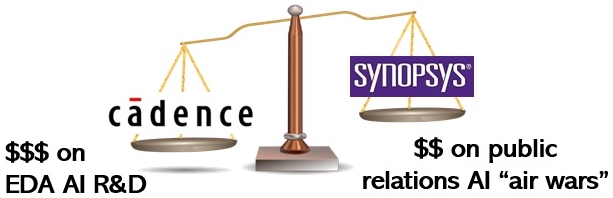
 Cooley: Tom.  Aart has been doing really well in the air war for
         artificial intelligence.  I'm just seeing it everywhere.  His
         DSO.ai is everywhere.
         Synopsys.ai is repeatedly mentioned in the civilian press like
         the New York Times, Forbes, VentureBeat, making Synopsys look
         like they are kicking ass in the AI world.

         Does Cadence have marketing guys?

         [ audience laughter ]

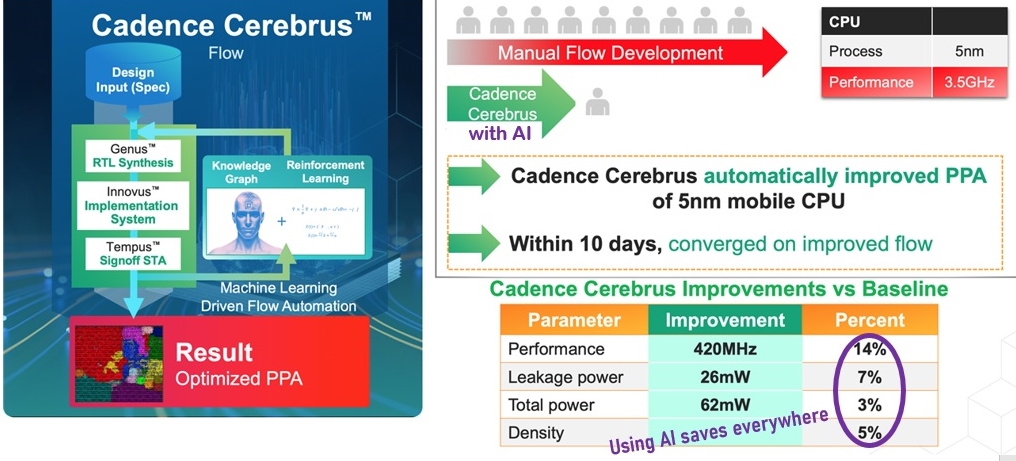
Beckley: Well, my first comment would be that Cadence Cerebrus with its AI
         is competing very effectively and in fact, doing extremely well
         in the marketplace.

         And we would rather put our money into R&D to make our products.

         [ audience laughter and clapping ]
         I think all AI and ML (Machine Learning) is in its infancy.

         I think 30 to 40 years from now, we'll look back and it'll be just
         like printing press and the steam engine and electric motors.

         It's going to permeate everything.
         So right now, there's a lot of interest in AI/ML, but in many
         ways, I think how it's being pragmatically used to really
         change efficiency is different.

         So, people are now putting their toe in the AI water.  What we're
         finding is that whether it's Cadence Cerebrus (digital PnR) or
         whether it's in my space (full custom layout)...
         ... like Optimality, where Cadence has brought ML capabilities
         into Clarity for EM (electromagnetic), Celsius for electrothermal,
         and Sigrity -- what we're finding is that this design space is
         too large.  People can't comprehend this design space.

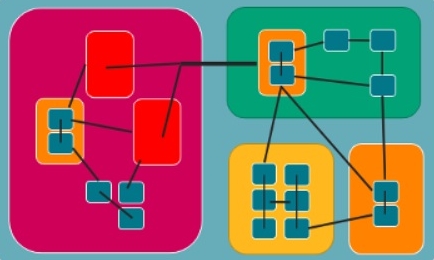
         Once the designers pick their topology, we can help them find and
         avoid local minima and maxima -- and optimize to that topology.

         And by using the power of the cloud, and by using the power of
         machine learning, we can give them a chance to do other topology
         exploration, to do some "what if" analysis.

 Cooley: Okay.

Beckley: I think that's where we're at, both on the digital chip side, and
         on the kind of chip/package/board side of the equation.   And I
         think it's true for all of us.

 Cooley: Dean.  You've been pushing Big Data since 2014.  Are you still on
         that path or even jumped over to the AI/machine learning bandwagon,
         just like everybody else?

   Dean: Well, I'm a big fan of AI.  And I've been investing heavily in AI
         at one of my other companies, Eagle Eye Networks, in the video
         surveillance base -- where I think AI is going to have a huge
         impact analyzing video surveillance in a big way.

         But the key to any AI is data.  You got to have the data -- data is
         training, right?  AI is all about training, training, training.  You
         have to have huge data sets, and so the DDM and management of those
         datasets becomes important.  But the big data storage and database
         to fill all the AI is really important.
         So, we're still doing the big data stuff at IC Manage, to track and
         understand what's being done with the design, what parts of the
         design, etc.

 Cooley: But Cadence Tom's tools automatically do it -- and probably Mentor
         Ravi's does, too.

   Dean: AI is going to be, in my mind, super vertically, super application
         focused.  You're going to have AI that can do this very specific
         task.

         The typical example is in surveillance video or in images or on
         Google images, is we've trained this AI engine.
         It's taken 14 engineers and 3,000,000 images.  And we've trained
         it to detect a dog or no dog.  Right?

         And so, if you need to know dog, or no dog, you've got this AI that
         can tell you dog or no dog.

 Cooley: Right.

   Dean: And you know, and you might get your AI engine so that it can
         actually recognize the super high, the super fancy stuff.
         They've trained your AI engine so it can actually identify like
         100 animals; or 100 different objects that's in an image.

         And you think about that AI applied to EDA.  Or to designing chips.

         I mean, we face 1,000 different problems.  And there's going
         to be an AI thing that will be trained (or taught) that "here's
         how you solve this particular problem."
         What Tom was talking about is, this is AI that will give you some
         guidance about how to partition your design.  Okay.

         Well, that's only useful after you've got a certain chip layout
         topology started and you got some place to start.
         But you know the AI on how to build an adder circuit -- the AI
         will decide on which IP you should use, etc....  it's going to
         be different AIs trained in a 1,000 different ways.

         You need data for all of that -- and IC Manage is all about the
         data.

 Cooley: Ok.  All right

   Tony: And moving the data around.

Beckley: Yes, but I think we should be careful....  The chip data is the
         customer's chip data, right?  I mean, so that's how your AI is
         going to build your foundation models.

   Dean: Is it?  Is the data going to be customer data?  Are you
         guys (at Cadence or Synopsys or Mentor) going to take chip data
         from 100s of customers and create really smart AI that can
         design a chip?

Beckley: Not unless we want to go to jail.

         [ audience laughter ]
   Dean: Well, so then, how are you going to ... So, are you telling me
         that the customers need to do their own AI training, in order
         to use AI in your tools?

Beckley: I'm saying that the customers own the large data sets.

   Dean: Sure, of course...  But how are you (at Cadence/Synopsys/Mentor)
         going to train your AI?

Beckley: Of course, we have some of our own Cadence designs that we use,
         and then we partner with the customer.

         But to be fair, if you want to go across platforms and you want
         to go across vertical segments -- that's owned data, right?

         That's how they win or lose in the marketplace.
   Dean: Yes.  To get vertical.

Beckley: Yes.

        ----    ----    ----    ----    ----    ----    ----

Related Articles

    Anirudh's 9 AI jabs at Synopsys and Ansys from his CDNlive'23 keynote
    Reader snarkies on Anirudh 2023 vs. Synopsys.ai, ChatGPT, and chiplets
    Dean, Anirudh, and Sawicki debate on Big Data versus Machine Learning
Join
Index
Next->Item
|
|