( ESNUG 588 Item 24 ) --------------------------------------------- [10/30/20]

Subject: Anirudh on his Clarity/AWR/EMX end run around ANSS/SNPS in 3D IC
                     Virtual DAC'20 Troublemakers Panel


   Cooley: Anirudh, last year you bragged about Clarity doing a frontal
           assault against Ansys HFSS.  You had a new matrix solution.
           You had 6 users doing benchmarks and they were saying Clarity
           was 3-15x faster than Ansys HFSS.  (ESNUG 588 #17 and #18.)

           So, are you done?  I mean, yay, congratulations.  You just kick
           back and drink mai tais and have a party?

  Anirudh: Well, we are pretty happy with how Clarity is doing.  And I think
           you wrote an article comparing it vs other tools.  (ESNUG 586 #5)
           So, we are pretty happy.  You know we launched it about a year
           ago, I think last April, and we have a lot of customers.  A lot
           of competitive benchmarks.

           It's doing pretty well.  But it's a big market so we must work
           with all the customers, get initial deployments, get wider
           deployments, and keep improving the tool just like in any other
           market segment.

           But we are confident about the technology.  The customers want
           the integration of this kind of simulation at the system level
           with the chip level.  All our major customers are interested in
           EM analysis and 3D analysis.

           So I'm cautiously optimistic.


   Cooley: You're doing RFIC EM extraction and you bought AWR for millimeter
           and microwave RF design.  But Ansys already bought Helic.  Are
           you playing catch-up with Helic?  And more basically, playing
           catch-up with Ansys again?


  Anirudh: Well, John, we bought Integrand for extraction and AWR for RF
           implementation.  And I'm pretty happy with both of those
           companies and products.
           Integrand Software, I believe, has the best Method-of-Moment
           solver for RF and Interposer extraction.  It started out of a
           few key people after Bell Labs.

           Even years ago, I always respected Integrand as the best RF
           extractor.  So, when we had an opportunity to acquire Integrand,
           we were very happy -- and all the key people have joined Cadence.

           The thing with Integrand and other things is it's not just for
           RF.  RF is critical on-chip and at the module level.  The other
           thing I want to highlight, what I'm really excited about -- is
           this whole 3D IC.  System-on-a-Package, on Interposer.

           Historically, the system-on-a-package was used to combine some
           esoteric analog technology with digital technology; and that's
           still there.

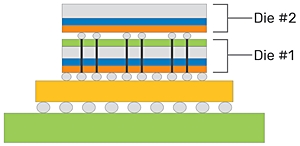
           But right now, what I see is the advancement of Moore's Law;
           multiple high-end digital chips are going on an Interposer or
           an InFO (Integrated Fan-Out) package.

           And that's going to be huge.

           These things are connected by silicon, in the case of Interposer.
           And in that case also, our Integrand SW has the best solution to
           extract those silicon geometries for 3D IC.  And this is going
           to be a big trend in the industry for next 3 to 5 years.
           So, we are making sure that we [at Cadence] have the best
           solution for 3D IC and the system-level integration.  Whether
           it's at Interposer or InFO or advanced packaging.


   Cooley: How does that differ from what Apache has right now?  Apache,
           Ansys, Helic; they do a similar...  Totem...  you know you take
           all those packages...  they do the same thing.


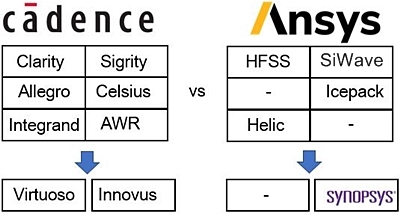
  Anirudh: Just to clarify, so Allegro is the premier packaging solution
           in the market.


   Cooley: Yeah, it is.  I have to agree.


  Anirudh: Allegro is PCB and packaging.  So, most of the premier packaging
           solution is done in Allegro.  That's the implementation platform.
           That is going to get more and more critical in my mind.  And when
           you do Interposer, it's an interplay of Allegro with Innovus --
           with digital -- and Virtuoso.

           So, Cadence is getting ready for -- we have the best solution of
           Allegro in packaging -- and analog in Virtuoso -- and digital
           with Innovus -- is to be the best implementation platform.

           So, I believe that will be the best implementation platform.


   Cooley: I can see that.  That's a distinct advantage because Synopsys,
           the only thing they're doing is they're teaming up...
           I mean Ansys is teaming up with Synopsys to try to do that.
           That's the best they can do.


  Anirudh: And there's interplay in these things.  So, if you look at some
           of the major foundries, they used to do InFO and Interposer, now
           they are merging InFO and Interposter together.
           You know InFO is a more bump-related technology, Interposer is
           more silicon substrate.  And all these big companies... this is
           going to be a big thing.

           So that's on the implementation side.  We want to make sure we
           at Cadence have the best solution.  Then on top of that you put
           analysis.

           So, our EMX (Integrand) plays a key role in analysis, and then
           our Clarity, and our Celsius.  The most important analysis that
           I see talking to our customers and big partners is thermal
           analysis for 3D IC and extraction.

           With CDNS Celsius and thermal analysis, with CDNS Integrand EMX
           for extraction, we can provide a pretty good solution.

           This is very exciting.  This is going to be a huge thing for the
           industry.  Because if you look at the last 5 to 10 years,
           most of the Moore's law is driven by integration -- putting more
           things on the chip.  The CPU runs at 3 or 4 GHz -- but instead
           of 1 CPU, you have 8 CPUs.

|
"If you look at the last 5 to 10 years,
Moore's Law is driven more by
integration than transistor scaling."
- Anirudh Devgan of Cadence
|
           If you look at the last 5 to 10 years, Moore's Law is driven more
           by integration than transistor scaling.  If you look at 3D IC and
           having multiple chips on a package, it's a natural extension of
           that integration to build really big systems.  So, we want to
           make sure we have the best tools and technologies and IPs to
           support this next wave of industry innovation.


   Cooley: The differentiation you're saying is you're [Cadence] going to
           have the entire flow under one company as opposed to doing a
           combination of Ansys and Synopsys?


  Anirudh: First, I always believe that you must have a comprehensive
           solution, but each tool has to be best-in-class.  You know this
           is what we have built over the last 5-10 years.
           So Allegro, I believe, is the premier packaging solution,
           best-in-class tool.  Innovus is the best-in-class implementation
           tool.  Virtuoso is the best-in-class analog tool.  Put them
           together, Celsius and Clarity are the best-in-class 3D and
           thermal tools.

           Integrand, I'm very excited about, is the best-in-class Method of
           Moment extractor.  So, this is how we build products and provide
           the best solutions to our customers.


   Cooley: I'll give you the first three.  Allegro is definitely there,
           Innovis is definitely there, what was the other one...  But my
           point is, you're projecting to the other two that are small
           market share, small players.  Clarity is still...


  Anirudh: Best-in-class technology -- that's what I believe.  And then we
           also want to make sure that, not only do we at Cadence have
           best-in-class tools and a comprehensive flow, we work with the
           leading teaching customers.  You know this business.  It's
           working with leading foundries and leading customers so they can
           guide us to customize our tools.  (ESNUG 547 #7, 586 #1, 561 #1)
           What I'm trying to say is we want to make sure we have all of the
           pieces to do 3D IC -- including RF, including analog, including
           digital, including packaging; and then work with the key teaching
           customers to drive this to proliferation.

           So, that's why we made these specific acquisitions.  The overall
           strategy is to provide the best solution for 3D IC and chiplets,
           which is going to be a big thing in the next five years.

           Mark my words -- it's going to be a big trend.


   Cooley: Alright, okay, cool.  Thank you.


        ----    ----    ----    ----    ----    ----   ----

Related Articles:

    Anirudh on his Clarity/AWR/EMX end run around ANSS/SNPS in 3D IC
    Mo on Movellus customizable PLLs/DLLs are Netflix, not Blockbuster
    Naveed on SiFive's reaction to ARM's reactions to SiFive's actions

    Sawicki on his "free" AFS-XT being 5x-10x faster than Spectre-X
    Costello on Metrics cloud in 4 hours vs. SNPS/CDNS/MENT's 5 days
    Prakash on functional static sign-off to grow 2X in 5 years, $300M
Join
Index
Next->Item
|
|