( ESNUG 521 Item 6 ) -------------------------------------------- [03/28/13]
From: [ Denis Dutoit of CEA-Leti ]
Subject: Spyglass Power for both architectural and RTL power reduction
Hi, John,
We've used Atrenta Spyglass Power for about 2 years. Our typical projects
tend to run 10-12 months. I would estimate we've had a 2 months savings
with it. That's roughly a 17% project time savings for us.
At my company we have 2 primary types of Spyglass users:
1) Architects,
and 2) Senior Power Designers.
Our architects use Spyglass at the architectural level as follows:
1. Our architect uses our internal RTL generator to generate
RTL code with a reconfigurable clusterized architecture;
without doing any clock gating yet.
2. The architect then runs Spyglass Power to find power bugs.
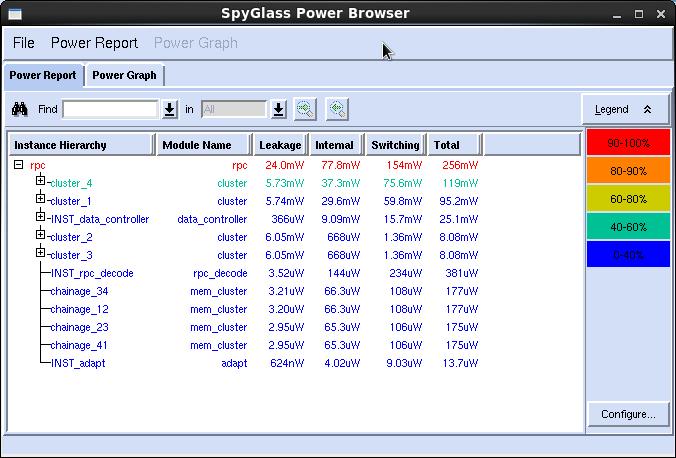 Power figures for hierarchical modules
There is a feature of Spyglass Power which gives you a graph of
every activity in the design, allowing us to see the activity is
for a particular block, even without actually doing any power
computations.
3. In one case, the architect found a power bug which affected 96% of
our programmable core.
Power figures for hierarchical modules
There is a feature of Spyglass Power which gives you a graph of
every activity in the design, allowing us to see the activity is
for a particular block, even without actually doing any power
computations.
3. In one case, the architect found a power bug which affected 96% of
our programmable core.
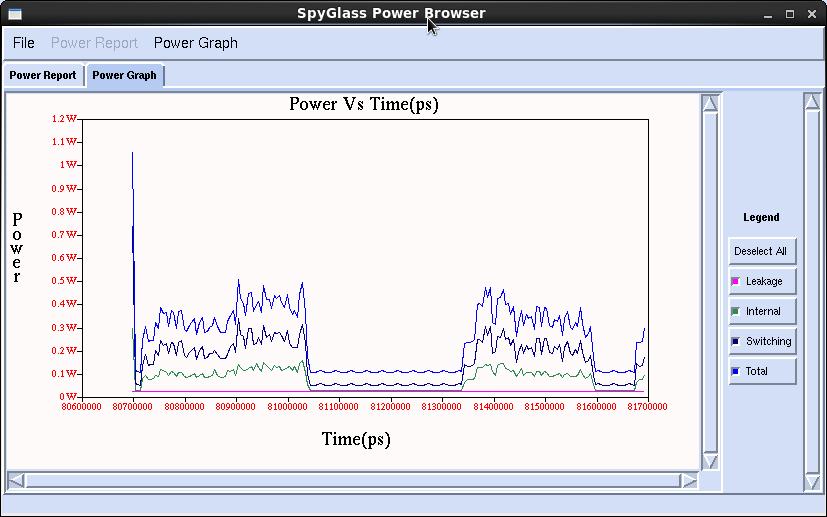 Power graph for architecture
This was a situation where the Spyglass Power activity report showed
that a cluster of the design that should have been in an idle state
was active and drawing power when it shouldn't have been.
4. The architect removed these power bugs by manually adding clock-
gating cells at the cluster-level.
5. He then did final analysis for clock-gating. We can extract a lot
of different reports with Spyglass, such as what is clocked and
what is not clocked; this helps to guide us in developing
micro-architecture.
6. We then used Spyglass' power optimization which gave us a power
savings from 9% to 45% at the architectural level when running a
set of benchmarks.
---- ---- ---- ---- ---- ---- ----
MICRO-ARCHITECTURE POWER ESTIMATES:
We came up with a clever way to use Spyglass to create a power model to
analyze power consumption and optimize our programmable core design at the
architectural level.
a. We had a complete instruction set for our small RISC CPU. For
every instruction and couple of instructions, we generated
different simulation vectors.
b. We input simulation vectors to Spyglass, to get power estimates.
c. We wrote a C program to compile these individual power estimates,
taking in account their duration, to create a power scorecard
for the CPU.
From here we could estimate/analyze our microarchitecture power budget.
The register file was our greediest module. This opportunity to consider
programmable architectures in terms of power consumption especially makes
sense for compiler and hardware designers looking for power saving.
---- ---- ---- ---- ---- ---- ----
RTL POWER REDUCTION CASE STUDIES:
The other primary users of Spyglass power are our experts in low-power
design. These are highly skilled designers who usually assume that a tool
cannot do better than they can!
We have recently used Spyglass on two different chips; below I have 4 sample
case studies of our power reduction results.
Design Size Power before Power after Power
Type (registers) Spyglass Spyglass Reduction
1 Ultra-low 11,821 12.1 mW 11.8 mW 2%
power
DSP core
2 Bit level 5,504 67.4 mW 58.7 mW 13%
translation
inside
3GPP-LTE
3 BCJR turbo 3,286 108.0 mW 88.3 mW 18%
decoder (+ 10 memories)
inside
3GPP-LTE
For each of the above case studies, the power reduction was done using
either Spyglass' manual/guided optimization or automated optimization modes
as follows:
1. automated
2. guided
3. automated
Design 1: The initial power reduction done by one of our best local
designers. Even so Spyglass got us another 2% reduction.
Spyglass Power looked at every single register and memory
inside the block -- there can be 10,000's of them -- to see
if it could gate them. It then optimized the remaining
registers/flip-flops, which were impossible for us to find
by hand.
Design 2: Most of the 13% power reduction came from Spyglass
automatically gating registers/flip-flops.
Design 3: Most of the 18% power reduction came from Spyglass' memory
gating. The memory power reduction comes from rules such as:
chip select gating, redundant read, and redundant write.
Spyglass' automated optimization often finds more opportunities for power
reduction optimization beyond our manual/guided manual optimization.
Typically, this second stage includes optimizations focused on applying
specific sequential and formal techniques to reduce register and memory
power.
---- ---- ---- ---- ---- ---- ----
POWER ESTIMATION:
We've run a lot of correlations to assess for Spyglass' power estimation
accuracy. It is within 2% to 10% of our golden power sign-off, which is
Synopsys Primetime Power. Suffice to say, that is absolutely precise enough
to make design decisions for power reduction.
If we do not have simulation vectors, then Spyglass can work with default
activity parameters to provide rough estimation. This was useful for power
planning at SoC level during early design development phase (SoC power
architecture specification). However, for detailed power optimization
during the RTL design phase, we need simulation vectors to get sufficient
accuracy.
---- ---- ---- ---- ---- ---- ----
USING SPYGLASS POWER IN OUR DESIGN FLOW:
First we run simulation vectors to functionally verify our design; we mostly
design in VHDL, with some Verilog.
Next, we run Spyglass Power, using the simulation vectors. Spyglass has no
problems with mixed language support. We can instantiated a VHDL module
within Verilog, and we can instantiated a Verilog module within Verilog.
Vector Vector Spyglass Power
Example Format File Size Load time
------- ------ --------- ---------
1 vcd 1.5 GB 4 min
2 vcd 20.0 MB 5 sec
Spyglass Power input:
- RTL code. Spyglass supports: Verilog, VHDL, System Verilog
- Library files
- Simulation vectors. Spyglass supports: .fsdb, .vcd and .saif.
Spyglass Power output:
- Written reports on activity and power consumption, such as
enable scorecards, clock-gating efficiency report, power
profiling report (blocks, clock domains, registers).
- If we use the automated optimization, it gives us modified RTL
When we do power transformations, there is a chance that you change design
behavior. Spyglass' sequential analysis and equivalence checking lets us
test this. Spyglass will automatically compare the modified RTL to the
original RTL, along with pass/fail reports, using a formal engine built
right into the tool. We use it, it works.
---- ---- ---- ---- ---- ---- ----
CONCLUSION:
Spyglass' design flow integration allows our designers to focus on the
results of the tool: power estimation and optimization.
We are a silicon conductor research institute. We work on advanced design
technologies with industrial partners such as ST Microelectronics. Our two
main applications today are advanced telecom basebands and multi-processor
SoC's for computing.
We have used Spyglass on recent designs with up to 1 Ghz clock speeds, and
are implemented in ST Micro 28 nm process, with Silicon on Insulator (SOI).
It's part of our mainstream design flow, and all the evidence is that
Spyglass Power will meet the needs of our new designs, which will be up to
2.5 Ghz and use a 14 nm process.
We are looking at new design optimization techniques using the substrate,
based on substrate polarization that changes, for example, the transistor
power consumption and speed. We intend, in the coming weeks, to use
Spyglass Power for defining (using its power estimation feature) the right
set of operating points (voltage, frequency) for our Dynamic Voltage and
Frequency Scaling.
We are happy with Spyglass. So far, we haven't seen any serious problems.
The tool is stable and we get same-day support. We have Atrenta R&D close
by, we know the Atrenta R&D folks, and cooperate well.
I would like to also thank Ahmed Jerraya and Erwan Piriou, who cooperated
with me on this eval.
- Denis Dutoit
CEA-Leti Institute Grenoble, France
Power graph for architecture
This was a situation where the Spyglass Power activity report showed
that a cluster of the design that should have been in an idle state
was active and drawing power when it shouldn't have been.
4. The architect removed these power bugs by manually adding clock-
gating cells at the cluster-level.
5. He then did final analysis for clock-gating. We can extract a lot
of different reports with Spyglass, such as what is clocked and
what is not clocked; this helps to guide us in developing
micro-architecture.
6. We then used Spyglass' power optimization which gave us a power
savings from 9% to 45% at the architectural level when running a
set of benchmarks.
---- ---- ---- ---- ---- ---- ----
MICRO-ARCHITECTURE POWER ESTIMATES:
We came up with a clever way to use Spyglass to create a power model to
analyze power consumption and optimize our programmable core design at the
architectural level.
a. We had a complete instruction set for our small RISC CPU. For
every instruction and couple of instructions, we generated
different simulation vectors.
b. We input simulation vectors to Spyglass, to get power estimates.
c. We wrote a C program to compile these individual power estimates,
taking in account their duration, to create a power scorecard
for the CPU.
From here we could estimate/analyze our microarchitecture power budget.
The register file was our greediest module. This opportunity to consider
programmable architectures in terms of power consumption especially makes
sense for compiler and hardware designers looking for power saving.
---- ---- ---- ---- ---- ---- ----
RTL POWER REDUCTION CASE STUDIES:
The other primary users of Spyglass power are our experts in low-power
design. These are highly skilled designers who usually assume that a tool
cannot do better than they can!
We have recently used Spyglass on two different chips; below I have 4 sample
case studies of our power reduction results.
Design Size Power before Power after Power
Type (registers) Spyglass Spyglass Reduction
1 Ultra-low 11,821 12.1 mW 11.8 mW 2%
power
DSP core
2 Bit level 5,504 67.4 mW 58.7 mW 13%
translation
inside
3GPP-LTE
3 BCJR turbo 3,286 108.0 mW 88.3 mW 18%
decoder (+ 10 memories)
inside
3GPP-LTE
For each of the above case studies, the power reduction was done using
either Spyglass' manual/guided optimization or automated optimization modes
as follows:
1. automated
2. guided
3. automated
Design 1: The initial power reduction done by one of our best local
designers. Even so Spyglass got us another 2% reduction.
Spyglass Power looked at every single register and memory
inside the block -- there can be 10,000's of them -- to see
if it could gate them. It then optimized the remaining
registers/flip-flops, which were impossible for us to find
by hand.
Design 2: Most of the 13% power reduction came from Spyglass
automatically gating registers/flip-flops.
Design 3: Most of the 18% power reduction came from Spyglass' memory
gating. The memory power reduction comes from rules such as:
chip select gating, redundant read, and redundant write.
Spyglass' automated optimization often finds more opportunities for power
reduction optimization beyond our manual/guided manual optimization.
Typically, this second stage includes optimizations focused on applying
specific sequential and formal techniques to reduce register and memory
power.
---- ---- ---- ---- ---- ---- ----
POWER ESTIMATION:
We've run a lot of correlations to assess for Spyglass' power estimation
accuracy. It is within 2% to 10% of our golden power sign-off, which is
Synopsys Primetime Power. Suffice to say, that is absolutely precise enough
to make design decisions for power reduction.
If we do not have simulation vectors, then Spyglass can work with default
activity parameters to provide rough estimation. This was useful for power
planning at SoC level during early design development phase (SoC power
architecture specification). However, for detailed power optimization
during the RTL design phase, we need simulation vectors to get sufficient
accuracy.
---- ---- ---- ---- ---- ---- ----
USING SPYGLASS POWER IN OUR DESIGN FLOW:
First we run simulation vectors to functionally verify our design; we mostly
design in VHDL, with some Verilog.
Next, we run Spyglass Power, using the simulation vectors. Spyglass has no
problems with mixed language support. We can instantiated a VHDL module
within Verilog, and we can instantiated a Verilog module within Verilog.
Vector Vector Spyglass Power
Example Format File Size Load time
------- ------ --------- ---------
1 vcd 1.5 GB 4 min
2 vcd 20.0 MB 5 sec
Spyglass Power input:
- RTL code. Spyglass supports: Verilog, VHDL, System Verilog
- Library files
- Simulation vectors. Spyglass supports: .fsdb, .vcd and .saif.
Spyglass Power output:
- Written reports on activity and power consumption, such as
enable scorecards, clock-gating efficiency report, power
profiling report (blocks, clock domains, registers).
- If we use the automated optimization, it gives us modified RTL
When we do power transformations, there is a chance that you change design
behavior. Spyglass' sequential analysis and equivalence checking lets us
test this. Spyglass will automatically compare the modified RTL to the
original RTL, along with pass/fail reports, using a formal engine built
right into the tool. We use it, it works.
---- ---- ---- ---- ---- ---- ----
CONCLUSION:
Spyglass' design flow integration allows our designers to focus on the
results of the tool: power estimation and optimization.
We are a silicon conductor research institute. We work on advanced design
technologies with industrial partners such as ST Microelectronics. Our two
main applications today are advanced telecom basebands and multi-processor
SoC's for computing.
We have used Spyglass on recent designs with up to 1 Ghz clock speeds, and
are implemented in ST Micro 28 nm process, with Silicon on Insulator (SOI).
It's part of our mainstream design flow, and all the evidence is that
Spyglass Power will meet the needs of our new designs, which will be up to
2.5 Ghz and use a 14 nm process.
We are looking at new design optimization techniques using the substrate,
based on substrate polarization that changes, for example, the transistor
power consumption and speed. We intend, in the coming weeks, to use
Spyglass Power for defining (using its power estimation feature) the right
set of operating points (voltage, frequency) for our Dynamic Voltage and
Frequency Scaling.
We are happy with Spyglass. So far, we haven't seen any serious problems.
The tool is stable and we get same-day support. We have Atrenta R&D close
by, we know the Atrenta R&D folks, and cooperate well.
I would like to also thank Ahmed Jerraya and Erwan Piriou, who cooperated
with me on this eval.
- Denis Dutoit
CEA-Leti Institute Grenoble, France
Join
Index
Next->Item
|
|